Ads

Monday, December 6, 2021

What Are Modal Verbs? | And How To Use Them With Examples

What Are Modal Verbs? And How To Use Them?

Model verbs show possibilities, intentions, abilities, or needs. Because they are a kind of auxiliary verb (auxiliary verb), they are used together with the main verbs of the sentence. Examples in general may include, should and must.

Model verbs can be difficult, especially when it comes to using them in a sentence. The good news is that learning them is easy. Below, we explain what you need to know in order to use modal verbs easily.

What Are Modal Verbs? 

Modal verbs are used to express some imaginary state, such as suggestion, power or request (the next section contains a complete list). These are used to slightly change its meaning with one of the main verbs. Since they are auxiliary verbs, they cannot necessarily be used on their own. (A modal verb should be viewed alone if it is clear from the context what the original verb is.)

Consider the difference between the following 2 (two) examples:
  • I swim every Monday. 
  • I can swim every Monday.

The first (1st) example is a simple practical statement. The speaker participates in a swimming activity every Monday.
The second (2nd) example uses the modal verb can. Notice how the meaning varies slightly. The speaker does not swim every Monday; They say they are able to swim every Monday if needed. It is speculative.
Thus, modal verbs are quite common in English, and you've probably seen them hundreds of times without knowing their names. Most commonly used:
  • can
  • may
  • might
  • could 
  • should
  • would
  • will
  • must

There are more model verbs, though the ones above are the most common. Some modal verbs are old and rarely used — as it should be and should be — while others are more conversational — such as get, need, or do. Some express very specific conditions that do not often come up, like dare, for example, "I dare to say." The phrase that is used, such as "I use to be an English student," also behaves like a standard verb.
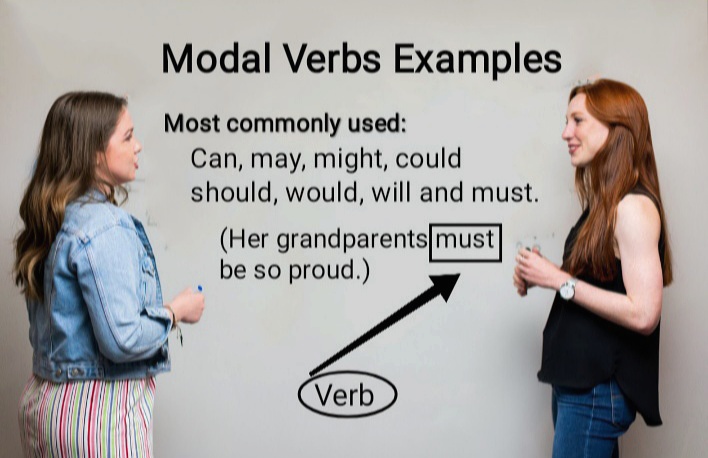
Modal verb examples

When Are Modal Verbs Used? 

What special conditions do modal verbs show? Here is a list of when to use model verbs with examples:

Likelihood
Some things may seem like it, but we don't know for sure. In this case, you can use modal verbs to show probability without certainty.
  • Her grandparents must be so proud. 
  • My baby sister should be asleep by now. 

Possibility
In situations where something is possible but not certain, modal verbs can, may or may not be used.
  • Judging by the clouds, it may rain today. 
  • He may become the youngest professional football player.

Ability
The modal verb can show whether the subject is capable of doing something, such as performing an action or demonstrating a power. Similarly, the negative form, can or will not, shows that the subject is unable to do anything.
  • He can speak four (4) languages, but none of them well. 
  • You can take a bear to the water, but you can't get it to drink.

Request
Similarly, if you ask another person to do something, start your question with will, would, could, or can.
  • Would you take this box off the top shelf?
  • Will you stop that music down?

Suggestion/ advice
What if you want to recommend something but don't order? If you are giving advice or advice to someone in the neighborhood without ordering, then you should use modal verbs.

  • You should try Lasagna.
  • That boy should wear less cologne.

Command
On the other hand, if you want to order someone, you have to use modal verbs, do or need.
  • You need to be here before 8 o'clock. 
  • You must wash your hands before eating.

Modal Verb Examples

All of the following sentences use modal verbs. Modal verbs are not usually used by yourself, so you can usually find them by searching for the original form of a verb before a verb or phrase that is working with it to change the meaning of a sentence. Note that modal verbs can also be used negatively.
 
  • Ants can carry much heavier objects than themselves.
  • If I had time, I might be able to collect groceries on the way home.
  • We need to wear masks so that no one can recognize us.
  • Should we walk to the school or ride our bikes?
  • Amanda couldn’t find her favorite shirt.
  • They weren’t able to convince Alex to give them money.
  • would give my puppies a bath, but they are still very young.


Summary: What Are Modal Verbs?

Define modal verbs: The definition of modal verbs is a specific type of auxiliary verb used to express probability.
  1. In short, a model verb
  2. Is a helping verb
  3. Must be used with a main verb
  4. Always a part of a verb phrase
  5. Can be negative
  6. Doesn't change form for different subjects

Saturday, December 4, 2021

What Is an Auxiliary Verb? | How To Uses With Examples

What Is an Auxiliary Verb? How To Uses With Example?

You may have heard auxiliary verbs referred to as auxiliary verbs, but what is such a verb and what does it do in English? When we say that it is "helping" a major verb, we mean that it is helping to clarify. Auxiliary verbs help to clarify whether an action will occur, when the main action occurs, who or what is responsible for that action, and whether we are asking a question. Explore what auxiliary verbs are and how to use them in English.

What Is An Auxiliary Verb? 

An auxiliary verb "helps" the main verb of a sentence by adding tense, voice, mood, or modality to the main verb. Auxiliary verbs cannot stand alone in sentences; In order to make money they have to be connected to a main verb.

Examples of Auxiliary Verb

Examples of Auxiliary Verb

Here are some examples of auxiliary verbs or verb phrases. In the following examples, the verb phrase is slanted and the auxiliary verb is in bold.
  • I have just made plans.
  • Did Matthew bring hot tea?
  • He had planned it another way.
  • He was baking a pie for dessert. 
  • Samy doesn’t ski or roller skate. 
  • John is taking Alex to the airport.
  • But he isn't listening to his bluffs.
  • Didn’t I ruin a lot of planned trips?
  • am going to make a trip to London. 
  • Uncle has been working hard all day.
  • don’t want to ruin this plan this time.
  • cannot really dear her creepy attitude.
  • She is doing it for fixing a date for them. 
  • The bed was made as soon as Dad got up.
  • Now she is convincing her to go with him.
  • Mary is writing a message to his boyfriend.
  • His boyfriend didn't know anything about it.
  • must find an alternative place to go if he goes.
  • Has Emilia been planning to go on a trip to Canada? 
  • I will not go with him even if there is no other option.
  • Recently she has heard that a restaurant is offering a good deal for couples.
  • Instantly, she was excited and penciled a table for them.
  • However, she should have consulted his boyfriend first.
  • Do you want to go alone or do you want to go with her?
  • Moreover, I will not go to United Kingdom if she goes there.
  • Did he know that he had become the most hated man in the world?

Auxiliary Verbs To Be, Do, and Have

Since some of these words are "to be" verbs, which can serve as main verbs, it is important to know the difference between the two (2). According to the "American Heritage Guide to Contemporary Usage and Style", there are four (4) ways in which auxiliary verbs differ from main verbs.

First, auxiliary verbs do not end the word to create particles or to agree with their subject and thus it is correct to say "I can go" but it is wrong to say "I can go". Second, auxiliary verbs precede negative clauses and do not use the word "do" to form them. The main verb must use "do" to form a negative and not like the phrase "we don't dance".

Auxiliary verbs also always come before the topic in a question, where the main verbs use "do" and follow the subject to form the question. Therefore, the word "can" in the question is "Can I have another apple?" 'Do you want to go to the movies?' Acts as main verb.

The final difference between the two forms of the verb is that the auxiliary words take the infinitive without the need for the word "to", as in the sentence "I will call you tomorrow." On the other hand, the main verbs that take an infinitive always use the word "to" such as "I promise to call you tomorrow."


Auxiliary Verb Exercises

Fill in the gaps with the correct auxiliary verbs from the choices presented below:
  1. What stage _______________ the kids at when you last saw them? (was, were, are, did, been)
  2. Jessica ________________ always wanted to try skydiving. (was, doesn’t, has, is, have)
  3. Where _________________ you go for summer vacation? (were, been, are, did, does)
  4. Why do you think he __________ call you like he said he would? (didn’t, is, hasn’t, has been, have)
  5. Mick ____________ going to be upset when he hears what happened. (will, don’t, is, didn’t, has)
  6. Megha ___________ want to go to the movies; she wants to stay home instead. (doesn’t, isn’t, wasn’t, hasn’t, was not)
  7. I _________________ appreciate his jokes. (did, have, been, didn’t, haven’t)
  8. I really like meat but I _____________ care for fish. (weren’t, been, don’t, is, was)
  9. Where _____________ you going when I saw you last day? (were, was, is, do, did)
  10. Jack ________________ called yet; he’s late as usual. (are, were, has, hasn’t, wouldn’t)

Answers: 1 – were, 2 – has, 3 – did, 4 – didn’t, 5 – is, 6 – doesn’t, 7 – didn’t, 8 – don’t, 9 – were, 10 – hasn’t


When Are Auxiliary Verbs Taught?

Auxiliary verbs are taught during elementary school English based lessons. Kids will be encouraged to use auxiliary verbs in their writing and you can use the excellent range of Education Sciences Topic to help you with that.


Thursday, December 2, 2021

What Is A Linking Verb | And How to use Them | With Examples

What Is A Linking Verb?

A linking verb connects the subject of a sentence to a word that gives information about the subject, such as a condition or relation. They show no action; They simply connect the subject to the rest of the sentence. For example, the word in the sentence "they are a problem" is the linking verb that connects them and the problem to show the relationship between the two (2) words. The most common of linking verbs are forms of the verb "to be": am, is, are, was, were, being, been. Understand the concept completely to see more linking verb examples.

So we come to the point that linking is not an action verb. What matters isn't what he is doing. For example: Snehar's cat is tired, here it shows the condition of Snehar's cat, not what it is doing. So here “is” is acting as a linking verb.


Linking Verb Examples Sentences

Since we ask "What is a linking verb?" I answered the question. Here are some examples of linking verbs used in sentences with bold verbs:

  • am holding her hands.
  • The meats smell rotten.
  • They will be happy forever.
  • Anthony had a nice dream.
  • All the kittens were playing.
  • Sometimes, kids are stupid.
  • Michael is fond of spicy food.
  • Cinnamon roll heavenly taste.
  • Your wedding plans sound fine.
  • She went blue after tripping on the rug.
  • But you are being foolish to believe her.
  • Watson  is excited about his promotion.
  • It was difficult for them to build a house.
  • Jumping into a sea could be dangerous.
  • The tests indicate that your kids is gifted.
  • You look exhausted after studying all day.
  • After the blizzard, the roads were slippery.
  • When dreams come true we believe them.
  • He seems upset about the announcement.
  • Nelson was nostalgic on her 40th birthday.
  • feel worthy when the sir compliments me.
  • We are disappointed about the foreclosure.
  • Riding in a bike will be safer with a seat belt.
  • If you don't, your friend may be disappointed.
  • The weather was fine and the party continued.
  • When the show started, the theater went dark.
  • Most student get cranky when they are sleepy.
  • Roman felt sleepy after eating the whole pizza.
  • The Army department is getting tough on crime.
  • The fruits in the bin looked disgusting and spoiled.
  • Jerry might have been forthcoming with the latest news.
  • Jack acted nervous when the teacher found the note.
  • The audience fell silent as the conductor walked on the stage.
  • The crowd remained calm despite the impending threat.
  • All the student seem satisfied with the bouncy castle.
  • The spectators are silent after getting injured on the field.
  • She became suspicious when she saw the safe was open.
  • Some couples are lucky enough to grow new together.
  • A flaw in design appeared to be the cause of the collapse.
  • He remains faithful, even though it has been three years since he left.


How Do You Recognize A Linking Verb?

A linking verbs work differently than many others, so it's important to know how we use them in sentences and clauses.

  1. Linking verbs can function as intransitive verbs, which do not take direct objects. Linking verbs do not take direct objects. The presence of a direct object in a sentence/ section will alert you that the verb used with it is not a linking verb.
  2. Linking verbs never refer to verbs, which means they are never verbs. All linking verbs are also static verbs, but not all static verbs are linking verbs.
  3. You can replace the verb with is or and if the sentence is still meaningful, then your verb is probably a linking verb. Let's look at an example: Tony sees happy. If we substitute "see" with "is", we get: Tony happy. The second sentence is understandable, meaning "looks" is a linking verb.
  4. You can substitute verbs with an equal sign (=). If the sentence isn't awkward the verb is almost certainly a linking verb. Here's an example: This music sounds great. This music = great, so "sound" is also a linking verb.
  5. The ultimate strategy is to determine whether the verb describes a state or an action. If the verb describes the state of the subject, it is probably a linking verb. However, if the verb describes a verb, it is probably not. Let's look at the example: Daisy smells nice. Is Daisy doing anything? No, they just smell nice. This means that "smell" is a linking verb in this sentence.

A Video Summary

Here is a short video explaining what we can understand by subordinate conjunction.


Function

The linking verb shows the relationship between the subject and the complement of a sentence. A linking verb connects a subject with words and phrases that provide additional information about the subject, such as an existing relationship or condition.
